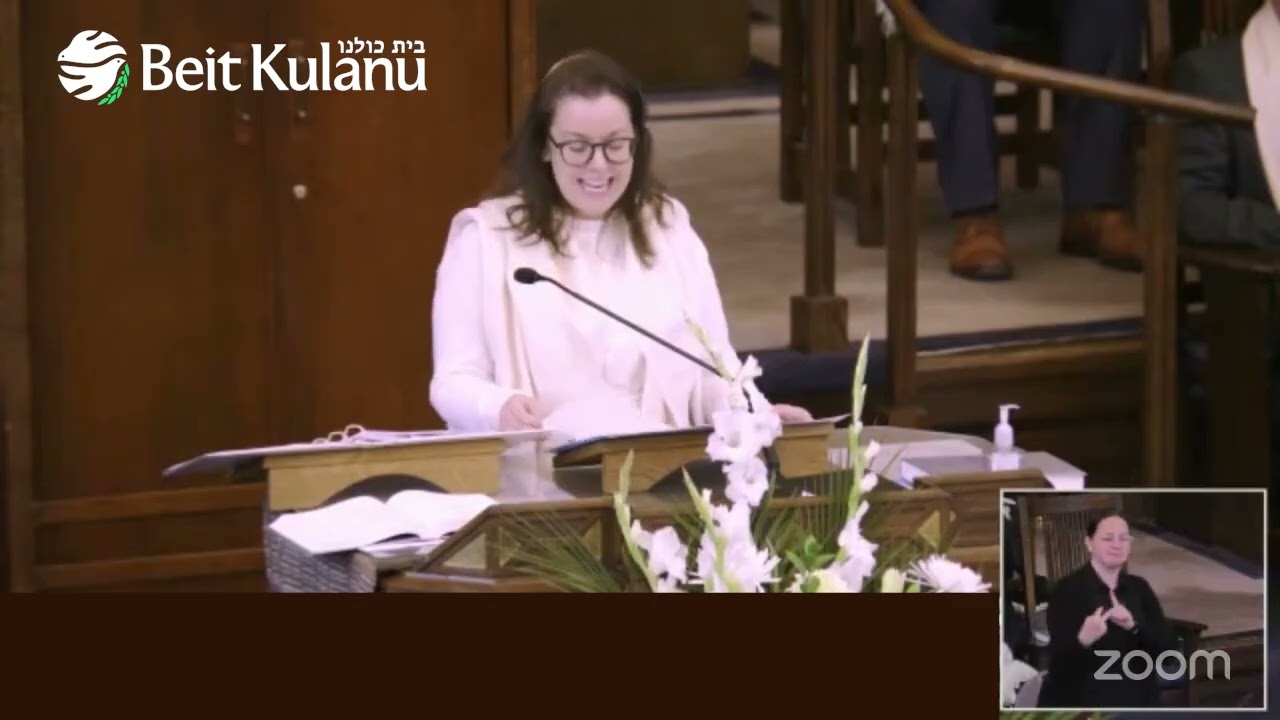
Transcript of Rabbi Erika Purdy-Patrick’s Yom Kippur Sermon
Beyond the Resume: What Will We Leave Behind?
Yom Kippur 5787
Rabbi Alan Lew, in his book, This is Real and You are Completely Unprepared, tells a story of Dr. Alfred Nobel, the inventor of dynamite.
The day after his brother died, Dr. Nobel opened the newspaper, expecting to read a tribute to his sibling. However, the newspaper mixed up the brothers’ names and accidentally printed Dr. Nobel’s obituary instead. He found himself in the strange position of reading his own obituary in the newspaper while he was still alive.
The article began with “Dr. Alfred Nobel, who became rich by finding ways to kill more people faster than ever before, died yesterday.” “That’s not how I want to be remembered!” Dr. Nobel said, throwing his obituary down. And right then, Dr. Nobel began to funnel his fortune into rewarding people for creating peace.
I’m sure that when you hear the name “Nobel,” you immediately think of the Nobel prize — not Dr. Alfred Nobel, the inventor of dynamite. Dr. Nobel transformed and altered his legacy after being forced to confront, unexpectedly and prematurely, what people might remember about his life.
The High Holy Day season gives us a similar opportunity. This is the time of year when we confront the very real and inevitable prospect of our own deaths, over and over again. Our liturgical poem, Unataneh Tokef, reminds us that our lives hang in the balance, and that anything can happen to us. We are asked to pause and consider: How have we lived our lives? What have we made of the years we have been given thus far?
We confront our mortality not simply to remind ourselves that we will die, but to remind ourselves of how we want to live.
How can we leave a legacy that we are proud of — one that wouldn’t make us throw the newspaper down like Dr. Nobel?
We spend so much of our lives thinking about the impressions that we leave on other people. We worry about what other people will say about our homes, our clothes, our jokes, or our politics. We think about how others will view our professional journeys or even our parenting styles.
And we spend enormous amounts of time working towards creating the perfect, polished resume: one that is full of the achievements, the degrees, the promotions, the honors that tell the world who we are — or at least who we want the world to think we are.
But when we confront our deaths, we realize that there is more to life than our resumes. Because the things that make a resume impressive are not necessarily the things that make a life meaningful.
When the time comes for our eulogy, people will hopefully not list every line item from our resumes. They will talk about how we treated people. They will talk about the relationships we built and the people we loved. They will remember how we showed up for others, our generosity, and how we gave back to the community.
The High Holy Days ask us to refocus our attention on our eulogy virtues, rather than allowing our lives to be defined only by the lines on our resumes.
The internships, the achievements, the dates and positions we list on our resumes do not necessarily require us to live up to any moral standards. Columnist David Brooks remarks that “if you live for external achievement, years pass and the deepest parts of you go unexplored and unstructured. You lack a moral vocabulary. It is easy to slip into a self-satisfied moral mediocrity.”
We can see this reflected in American culture. Our newspapers and magazines praise people for significant achievements — the kinds of things that look impressive on a resume — without necessarily asking about the virtuous, moral behavior we might hope to see in a eulogy.
The author Sarah Hurwitz points out that many of the most celebrated people in American life — actors, comedians, politicians — are known for their resumes. We know them for the elections they have won, the charts that they have topped, the money they have made at the box office.
And because we know them through these points on their resumes, we express a particular sense of surprise and appreciation for the moments when they also show us that they are virtuous and upright human beings. It feels like a nice, added bonus when we hear that a celebrity was kind, demonstrated humility, or that they held themselves accountable.
But Judaism challenges us to shift our perspective, to flip the script and discern what matters most even after we have left this life. It’s not the Grammy awards, it’s not the box office numbers. Our character, our relationships are the parts of our lives that make for a lasting legacy.
Our High Holy Day liturgy stands in direct contrast to the lines on our resumes and to our achievement driven society. The liturgy demands that we take a look inward. It asks us to reflect on both our missteps and our values before we pass away, before it is too late and we no longer have a say in how we are remembered.
On Kol Nidre and Yom Kippur, we review our lives and rehearse our deaths. On Kol Nidre, we are confronted with standing before an empty ark, symbolizing the great unknown that awaits us.
Rabbi Alan Lew writes: “We need a taste of this emptiness, to give us a sense of what will go with us, what will endure as we make this great crossing. What’s important? What is at the core of our life? What do we want to live on? Our money, our pride? Our anger, our selfishness? If not, we better let go of them now, before they become what we are, what we will always be in that great unknown for which we are bound.”
The vidui, our confession traditionally recited just before one dies and throughout the High Holy Days, does not ask us to lament every missed job opportunity, every award we failed to win, or every accolade that never came our way.
Instead, the vidui at the High Holy Days asks us to reflect on the ways that we have slipped up or have fallen short morally in the last year. The phrasing of the vidui makes us guilty as a collective: we say “Of these wrongs, we are guilty…we betray, we steal, we scorn…” etc.
However, I believe that there is another side to these statements — one that allows us to gently check in with ourselves and ask where our actions have been either in alignment, or out of alignment with our virtues.
We betray. Were we kind to others?
We steal. When did we give to those in need?
We scorn. When did we treat others with respect? When did we show people our appreciation?
The High Holy Days give us the opportunity to shift our mindset — to move beyond the question, “What have I accomplished?” and toward the question, “Who have I become, and who do I want to become?”
This shift can lead us toward deeper and more fulfilling lives, lives that extend beyond the lines on our resumes.
In her memoir Here All Along, Sarah Hurwitz reflects on what it meant to finally “make it” in her career. Hurwitz was the top speech writer for President Obama, and her office was in the White House. There were no more rungs of the ladder for her to climb. She had reached the top of her career.
And yet, despite all of that success, Hurwitz still felt unfulfilled. She felt as if there was an empty space in her life that work could not fill.
But then, she rekindled her relationship with Judaism. As she dove back into Judaism, Hurwitz learned about mindfulness and about approaching situations with compassion. She became more aware of the need to live out her ethics in a way that her career alone could not provide.
Even with her prestigious resume, Hurwitz recognized that if she wanted to feel more connected to other people, and leave behind a legacy rooted in her values, she needed to explore what these values actually meant to her.
And while we may confront the idea of our deaths most explicitly during the High Holy Days, Judaism gives us plenty of examples of how to live with virtue all year long.
When I think of virtuous behavior in the Torah, I often think of Rebecca and the servant at the well.
In Genesis 24:14, as Abraham’s servant searches for the woman whom Isaac will marry, the servant says that he will ask a woman for water at a well, and the woman will respond “Drink, and I will also water your camels.”
Rebecca says exactly that, and then she does it. She has no idea that this is a test. She has no idea that this act of generosity will alter the course of her entire life.
She simply sees a stranger who needs help, and she helps him. She acts with a sense of generosity and out of concern for this complete stranger, providing water for both the servant and his animals.
This moment in the Torah would never make it onto a resume, and yet it is an example of precisely the virtuous behavior we strive to embody, the kind of moment that makes a life meaningful.
Rebecca does not know that anyone is watching. She does not know that her actions in this moment will be remembered for generations.
She simply acts according to her values.
And perhaps that is the point. The most important acts in our lives are the ones that don’t make it onto the resume.
The moment we stop to help someone.
The apology we finally make.
The person we forgive.
The friend we call.
The stranger we welcome.
The time we give when no one is keeping score.
These values may not build our resume in this life. However, living our lives according to these values will allow our legacies to endure for generations to come.
And so, on this Yom Kippur, I invite us to imagine that we, like Dr. Nobel, are reading a newspaper with our own tribute.
What would it say?
Who wrote it?
What would we want it to say?
Are we living lives that could lead to that tribute?
We do not get to choose the exact words that will be written about us one day, but we do have some say in the stories behind those words.
That is the work of Yom Kippur. Not adding more lines onto our resumes, but becoming more intentional in our lives. Not worrying only about what we have accomplished, but asking ourselves who we have loved, whom we have helped, how we have treated people, and what we have given to the world.
Dr. Nobel got the rare gift of reading his obituary before it was too late to change it.
Through the High Holy Days, we are given that gift every year.
So let us use this gift. Let us think about the lives we are building, and not just the points we accumulate on our resumes. And then, together, let’s get to work.
G’mar chatimah tovah.