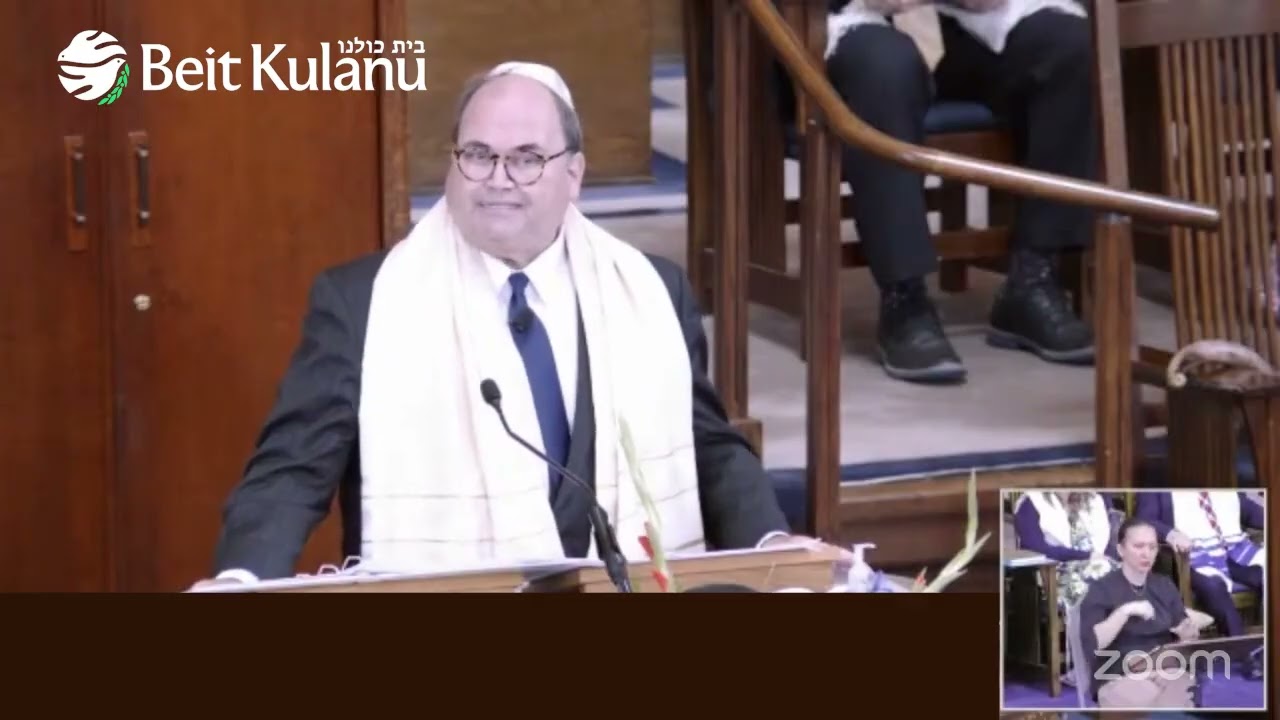
Transcript of Rabbi Daniel J. Fellman’s Rosh HaShanah Sermon
Rosh Hashanah 5787
The Old Shall Dream Dreams and the Youth Shall See Visions
Pittsburgh, PA | September 12, 2026—1 Tishri 5787
L’Shanah Tovah!
A Confession: our view is better than yours this morning! While you can see all of us—with the wonderful choir and honored guests here on the Bima, we can see all of you—the beauty and grandeur of a Jewish community gathered in an exquisite space together. How blessed we all are.
I must begin this morning with words of thanks. So many people have worked extraordinarily hard to create this moment. We gathered here today are the beneficiaries of generations of Jews who dreamed, built, reimagined, and risked to create a better Jewish world. Our very presence shines as an eternal symbol of hope.
The generations of Jews who saw the possibility of a thriving life here in the Alleghenies, the generations of Jews who built and nurtured Jewish communities and houses of worship, the generations of Jews who looked around, saw what existed, and proclaimed, ‘let’s do more!’—all deserve our gratitude this morning.
In particular, I wish to thank all who have been a part of the building of Beit Kulanu. Countless people have spent unknowable hours challenging and convincing and creating this new reality. We are all the better for the efforts of so many.
I want to thank those who day in and day out make Beit Kulanu a reality. From the maintenance staff—Dave and Steve and Luis and Sanjay and Mike and Tony to the security professionals who keep us safe—they allow us to do our sacred work, and in their work become holy partners with us.
We have assembled a wonderful team at Beit Kulanu, and they deserve recognition and thanks as well. Drew, Mirit, Kate, Tami, Danie, Yael, Don, Edie, Judy, Dana, Leslie, Mayda, Debbie, Eric, Pam, Mac, Diane, Dasya, Valli, Sam, Leah, the Rabbis who run our Religious School, Rabbis Larry Freedman and Stephanie Wolfe, Ellie and Katy who run our Early Childhood center and all of the teachers in both, and my clergy partners, Cantor David Reinwald and Rabbi Erika Purdy Patrick—each of them gives of themselves and has helped us begin to realize a bright new future together.
The skill, compassion, innovation, warmth and joy that each person brings to our community shines as a stunning reflection of the Divine, and I am humbled and honored to be a part of this group.
For most of modern American Jewish history, Pittsburgh’s Jewish community has occupied a unique and special place. More than any other city, ours has been at the vanguard of change in Jewish life. We have been the leaders, the dreamers, the ones who looked out, saw that our people were growing and changing and needed a response to those changes filled with love and determination.
Like so much of Pittsburgh, our Jewish community represents the very best of the American ideal. Pittsburgh has been home to heavy industry and high-tech advances. Pittsburgh shines as a city of neighborhoods and ethnicities living side by side, sharing the black and gold, building a better future for our children.
Our Jewish community knows how to come together, how to live together even as we have differences when it comes to religious practices and beliefs. Our Jewish community sees the human bond—and our shared covenant with each other and with the Almighty—as an invitation to be bold in creating for those who come next.
When Jews first started to settle in old Allegheny City in what we now know as the north side, they could never have imagined what they would seed. Those early and mid-19th century Jewish immigrants could not have imagined the bustling Jewish community that would develop between the Allegheny and the Mon.
They certainly could not have imagined a large hospital in their neighborhood that would spawn a Jewish tv character in an award-winning series who spoke of his synagogue in an episode! They were Jews in search of a better life for themselves and their offspring. They really were not so different from you and me.
In 1875, Rabbi Kaufman Kohler, one of the leading figures of early Reform Judaism, convened a conference of Rabbis here in Pittsburgh. The gathering was not large—only 18 rabbis, including Rabbi Lippman Mayer of Rodef Shalom who was the host of the conference. The document they produced—The Pittsburgh Platform—laid out a vision for American Judaism and Jewish life in the new world. Gone was much of the particularism associated with religious practice and the land of Israel, replaced with a universalism welcoming all and encouraging assimilation into American society.
That platform held as the guiding force for the Reform Movement for more than fifty years until a meeting in Columbus, Ohio produced a new platform in 1937. This new document, signed by 241 rabbis, marked a return to peoplehood, to an embrace of Zionism and connection with the land of Israel, and began to embrace a return to Jewish ritual. And in affirming the rights of labor and the pursuit of social justice, it became a foundation stone for the Reform Movement’s push for Tikun Olam, the repair of our world.
In 1976 the Reform movement met again, this time in San Francisco. Celebrating the 100th anniversary of the founding of our movement, they produced a platform embracing the three-part core of Jewish peoplehood—God, Torah, and Israel, while also emphasizing inclusivity.
And in 1999, a rabbinic gathering occurred again in Pittsburgh, and as before, produced a set of principles for our movement. At that gathering, 324 rabbis signed on, and our movement embraced a continued focus on God Torah and Israel, an embrace of the Hebrew language, a commitment to social justice, and a heavy emphasis on Jewish learning for all ages.
In the nearly 27 years since that document was adopted here in Pittsburgh, Jewish life has undergone major transformation. World events like September 11 and the Covid Pandemic, struggles in Israel, violence in synagogues and other houses of worship, pressures from the far right and far left in American politics and so many more influences have changed American Jewish life. We as American Jews have changed. And we Pittsburgh Jews have changed too.
The creation of Beit Kulanu stands as an important marker in the evolution of Jewish America. Just as Pittsburgh sparkled as a leader for American Jewry in 1875 and in 1999, the time has come again for us to stand and lead. American Jewry and American Jews are demanding new ideas, new possibilities, new moral clarity, new levels of inclusion and new understandings of our tradition. We are blessed by this moment in history, and we are called to act to create a Jewish future worthy of our offspring just as our ancestors did for us.
So, on this first day of the first year of Beit Kulanu, let us come together to create a new 21st Century Pittsburgh Platform, a model for Jewish life which responds to the times and embraces all that we treasure and value. This is the time to encourage all that is possible, to sanctify the privilege of wrestling with who we have been, who we are and who we wish to become. This is the time to revel in our blessings, to live the positive side of the words of Kohelet—this is a time to dance and celebrate and create! So much in our world right now tilts toward negativism. Our tradition, our legacy, our future urge us to respond with the exact opposite!
A new Pittsburgh Platform provides a path for prosperity and reinvigoration of Jewish life here in Pittsburgh, throughout the country and beyond. As with earlier generations, we begin with the values which define our community.
We Jews are committed to sacred wrestling with God, Torah, and Israel. Let us explore the Divine image we encounter when we look into the eyes of another person, and work to bring God out of the words of our history and into our everyday lives.
Let us live the words of Torah—not simply following commandments but building lives based on Jewish understandings of ethics and morality. And let us engage with Israel—not simply on political terms which may fit the debate of the day but more deeply as a theological pillar, the coming together of people and place to elevate all of humanity.
We treasure the gray area inherent in all three elements of our identity—God, Torah, and Israel even as we welcome the opportunity to see the beauty in universalism so present in the first Pittsburgh Platform and the beauty in particularism so present in the Second Pittsburgh Platform.
As a home for all, we Reform Jews of Beit Kulanu honor the centrality of our community as a center of hope and possibility. We see the sacred in doing for others, in learning and exploring, in honoring our past and dreaming of our future. We welcome exploration of the world through Jewish eyes for all ages—whether through travel to Israel or the Deep South or Portugal or any other locale. We savor learning of all kinds—just come to a Monday night Meet-up and see the menu of opportunities for learning each week! We have classes and programs on every subject from A to Z—from aardvarks to zucchini! And we hold a sacred commitment to honor our journeys, to honor our histories, to honor all who have made our reality possible.
And as we embark on this new era, we commit ourselves to a community of constant engagement. Whether we meet within these walls or anywhere else in the community, we see our home not just as a fortress from the storms but rather as a launching pad, a place which will allow us to explore, grow, experiment, give, collaborate and encircle.
Ours is a community which welcomes all, which sees the holiness of all, which keeps a place at the table for all, which offers a listening ear and a caring heart to all.
Jews of the 2020s, 2030s and 2040s need something new from their congregations and communities. We Jews need our communities to be places of healing, places of marvel and mystery, places of justice, places of comfort and acceptance. We need to be able to have tough political conversations in safety and sanctity, and we need to highlight the interconnectedness of our worlds. We need to connect with fellow Jews and with good people of all other faiths as well.
Rabbis Levy, Freehof, Jacob, Henry, Ilson, Gibson and more have paved a path for us. Each of them worked to create and change and meet the needs of a growing Jewish community in Pittsburgh. Today, the mantel has been passed to each of us. Their models of bold change, of exploring pockets of the Jewish world others avoided, of embracing learning and caring and doing become the foundation for our new home.
As we work to combine the values of our people, the mission of our calling at this moment in time and our vision of a new sacred community, we are charting the next great chapter in the Jewish story. At Passover we read that each generation is called to tell the story as if they themselves took part in the Exodus from Egypt. Today, we are called to enter into this new era of Jewish life with the same urgency as those who were part of the Exodus. We will carry all that is holy with us, and we will join together in creating a new Promised Land for ourselves and our families.
Above the Bima in this sacred space are painted the words of the Shema. Those words offer so much more than the kernel of our faith. They are a full sensory experience.
As we say the Shema we taste the sweetness of our celebrations together. We hear the echoes of earlier generations who taught us and prayed those words. We see how even under duress, our people stood upright uttering those words as they faced destruction. We feel the magnificence of our history, the singular honor of being heirs to a tradition of oneness. And if we crinkle our noses just right, letting the olfactory senses flex their muscles, spices and bouquets of every country where we have lived, prayed, and created become clear.
The 21st Century Pittsburgh Platform calls us to create a full sensory experience not just of the Shema, but of every prayer we utter. We are called to create learning environments which meet the needs of every learner. We are called to create opportunities for giving and doing for the less fortunate based on our sacred teachings and the commandments we share as participants in a covenant with God. We are called to create community—places to meet, celebrate, grieve, energize, cajole, imagine and visualize. We are called as Dr. Freehof once taught, to embrace the arts and use the arts to share our bounty and continue the work of creating our world. We are called, as the prophet Joel remind us, to dream dreams and see visions.
On this birthday of the world, the beginning of the year 5787, Pittsburgh’s Jewish community hears the call once again to lead. Join me as we build anew and together let us make Beit Kulanu a true fulfillment of its name—a home in every way, a place for every one of us.
The other day as I was one of many parents and children enjoying the opening of religious school, I thought to myself, I hope that one day in the future we will turn to our grandchildren, hold them with a loving embrace, and say, “We were part of something amazing, the building of Beit Kulanu. We helped create a Jewish community that would be a loving and kind home for all and extraordinary in every way. And now that community is yours to nourish you, give meaning to your life, and bless you each and every day.” Ken Yehi Ratzon, may this be God’s will. L’Shanah Tovah!