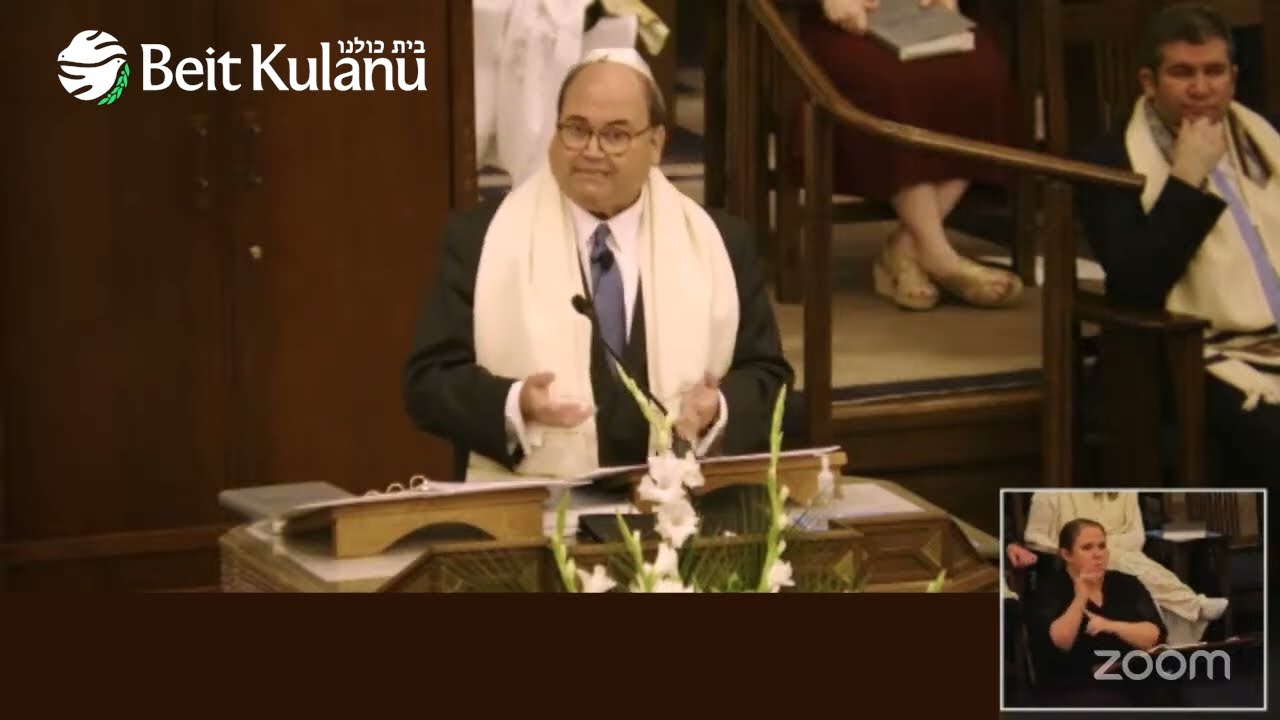
Transcript of Rabbi Daniel J. Fellman’s Kol Nidre Sermon
Kol Nidre 5787
A Jew in the World Today
Pittsburgh, PA | September 20, 2026—10 Tishri 5787
L’Shana Tovah!
We have begun the new year well together. Last week we joined in celebration and hope as we welcomed the year 5787 and together, we prayed and dreamed of a new future. Tonight, as we mark the Day of Atonement, we turn to our own individual selves, to our actions, our successes and missteps, our possibilities and our frailties.
Last week I thanked the staff who make Beit Kulanu what it is. Tonight, I want to begin by thanking another group who also give heart and soul. Earlier we welcomed a group of past presidents to the Bima, and we heard from our current president, Marcie Solomon. Each of these leaders, and the members of the boards and committees who served and serve with them, give of themselves to better our community. As volunteer leaders they devote time, talent, and treasure to all of us, and I am extraordinarily grateful for all that they do.
Over the past few years, I have watched as Marcie, Bill Battistone, Steve Jurman and the members of the Steering committee and the management committee worked to create the reality we are now living. To say that they dedicated themselves to this endeavor does not give enough credit. They lived, breathed, and worked through the challenges of uniting all of us, and they did so with compassion, wisdom, grace, charm, wit, and an undying optimism. I will forever be filled with awe and respect for all of them, and I know you join me in thanking them for all they have done for all of us.
This evening, we join with Jews all over the world in prayers which force us to ask the most difficult questions. Earlier we intoned the words of Kol Nidre, seeking forgiveness not just for past mistakes, but for vows we will not be able to keep in the coming year. These words have produced a one-two punch for Jews for millennia. On the one hand, such vows force us to confront our own mortality, our own demise. And on the other, the words of this prayer have inspired hatred and distrust of Jews from those who view these words not as an act of deep thought and prayer but rather as a conniving attempt to wiggle out of agreements. We face our own death, and we inspire hatred from others at the same time. Some gift for a new year!
In more quiet times, we have enjoyed the luxury of saying the words, being moved by the melodies, dreaming of a new year filled with possibility. But today, the place of a Jew in the modern world carries more angst, more challenge, more tzuris, more difficulty than most of us have faced in our lifetimes. Jews at the beginning of 5787 arrive in the new year with complicated patterns of hate coming from multiple directions, fear growing, education declining, community feeling pulled apart in ways unimagined. Yet we are here in this place at this moment, each of us having decided to spend this time with each other and with God. And in that simple decision a new path forward can be understood.
Even in these challenging times, I must recognize the unequaled opportunities we Jews enjoy in 2026. We live in times when Jews are not limited by neighborhood covenants or redlines, where Jews are not limited by quotas or glass ceilings., Jews are mentioned as leading candidates for the highest office in the land, Jews excel and continue to be leaders in every profession. In one sense, we have never been as blessed as we are at this moment.
Even with all the successes, Jews today face more discord, more disconnection, more painful diversions than at any time since the end of the Second World War. If the surveys are accurate, somewhere between 50 and 75 per cent of non-Orthodox Jews are unaffiliated, not connected to the Jewish community in any meaningful way. The separation does not result from poor communications.
The roots are deeper—Jewish educational systems which for too long tilted either too universalist or too particularist, a glaring inability to teach social justice not just as a moral calling but an essential Jewish calling, a challenging in letting go of past practices and an inability to embrace the needs of new generations. All these challenges can be seen here in Pittsburgh in our own community. Assigning blame helps no one. Rather, acknowledging the uniqueness of our times, reimagining our missions, reframing our visions, returning to our values—these are the paths which will help Jews reconnect with our tradition while making those same traditions meaningful in the most modern ways,
Two recently published books, both written by Jewish women, offer a stunning and sacred path forward in this new world. Sarah Hurwitz’s As A Jew, published just about one year ago, and Dara Horn’s The Final Solution to the Jewish Question published earlier this month combine to explain our current reality and provide a compelling case for communal resurgence. Neither author ever imagined writing the books they did, but both women saw in themselves and in society challenges crying out. And both women have delivered answers filled with sincerity, civility, seriousness, and sanctity.
Dara Horn’s voice emerged over the last few years as a major force in the Jewish world. After writing People Love Dead Jews and then the October 7 invasion and subsequent war and rise in anti-Jewish acts, Horn noticed that under the guise of human rights for Palestinians, groups all over the world began to attack Jews. Most directly, Horn noticed that the Anti-Zionist rhetoric mirrored the very same attacks lobbed by the Bolsheviks more than a century ago.
Let me be clear—I believe the Palestinian people have been abused by too many, most of all by terrorists bent on destruction. I believe in two states living side by side in peace and security. I am not a supporter of the settler movement or the far-right policies of the current Israeli government. And I believe deeply in the right and power of protest.
But as Horn describes in her book, those attacking Jews over the last few years have not been focusing on the Israeli government or its policies. Instead, they have again and again attacked Jews. People like you and me.
For us as Jews, Zionism is not a political construct alone. Zionism, at its root, is theological, part of our commitment to both the land and people of Israel. Criticize government policies all you want—but attacking Jews should be beyond the pale. These attacks have become the defining characteristic of Jewish life in America over the last few years. We are being attacked because of the policies of the Israeli government. Can you imagine attacks on Chinese restaurants over the Chinese government’s treatment of the Uyghurs like the attacks on Jewish restaurants and businesses we have witnessed over the last few years? Too easily, frustration with Israel has spilled over into hatred for Jews.
Dara Horn dared to do the research, and what she found should alarm all of us. While the rights of the Palestinian people are a real and pressing concern, their cause has been hijacked and consumed by those who instead are choosing generations long attacks on Jewish people and Jewish peoplehood. Horn founded the Tell Institute to create curricula to respond to this frightful trend, and I am proud to share that we will be teaching this curriculum to our middle schoolers and high schoolers this year. We hope to include adults in this important learning as well.
Dara Horn writes of Eli Sharabi, a hostage who spoke here in Pittsburgh last year. Sharabi endured horrors and somehow found a way to remember that life always has choices. He could daily choose to hold fast to his traditions, his beliefs, his values, or he could give in to his captors. He noted one captor who asked him, ‘why do we love death, and you the Jews love life?’[1] Sharabi recalled connecting with Hersh Goldberg-Polin while both were being held captive. Goldberg-Polin shared the words of Victor Frankl, a Holocaust survivor who wrote, “the one who has a why can bear any how.’[2]
This desire to do something, to make positive change has fueled a new effort among Reform congregations here in Pittsburgh. Along with Temple Emanuel of the South Hills, Beit Kulanu has begun a new program for our Bnai Mitzvah families called Connections to Reform Israel. We are inviting B’nai Mitzvah families to contribute to any one of many Reform groups in Israel working to change the matzav, the situation on the ground in Israel.
We are raising money so that each contribution made by a family will be matched by the fund. Additionally, instead of planting trees in honor of each student, we will as a congregation be making contributions to this same group of Reform organizations in Israel. Together with the Israeli Movement for Reform Judaism, we are building connections between Pittsburghers and Reform Jews in Israel, and we are working for change in government policies which affect all of us. Our why is the call of literacy, community, and memory, and we are making choices to embrace all that is possible.
In pursuing an increase in Jewish literacy, a new emphasis on Jewish community, and an embrace of memory, we are following all of these important ideas here at Beit Kulanu. We are offering more classes on Judaism and Jewish life than at any synagogue at any time in the history of Jewish Pittsburgh. Monday night meetups overflow with opportunities to learn. Tuesday Talmud, Torah study on Shabbat, an inventive and inviting learning program for our high school students, a comprehensive educational program for our elementary and middle school aged children, an inviting and welcoming Jewish learning environment for our littlest ones in the Early Childhood Center—each of these point to a commitment to more Jewish education at Beit Kulanu.
We are reimagining community in a thousand ways at Beit Kulanu. From creative holiday celebrations to inclusive services, bnai mitzvah tailored to each student, musical offerings, a world-class Biblical Garden and so much more, we are creating a new kind of Jewish community which welcomes all, embraces all, and provides a second place, a home away from home for all.
And we are embracing memory. We are honoring our history, learning from our past, working to connect our youngest members with our oldest. We recognize the power of remembering our past as we build a new future.
In all of this, we are making choices. We are engaging, not shrinking away. We are elevating Jewish tradition as Sarah Hurwitz describes in her book. Hurwitz writes: ‘Once we know our story, we need to own it.[3] Ours is a community big enough to welcome all, kind enough to nurture all, holy enough to celebrate the Divine in all.
Last December I traveled in a rabbinic delegation to Portugal. We were the second largest rabbinic gathering ever held in that country, and we spent a week traveling, meeting Jews and exploring Jewish history. What we found inspired all of us. When the inquisition sent Jews underground, Jewish mothers responded. While they raised their children as ‘new Christians,’ they maintained customs like candle lighting and Jewish dietary rules. And they made sure their children dated other ‘new Christians.’ By their actions, the women of Portugal preserved Judaism for generations.
When the twentieth century brought newfound openness, generations of ‘new Christians’ realized that they were actually Jews. And over the last 50 to 75 years, Jewish Portugal has blossomed. In Porto we prayed with the local Reform congregation, led by a female rabbi and a female cantorial soloist. As we welcomed Shabbat together, I sat in awe as women continued to lead Judaism forward on the Iberian Peninsula.
That Shabbat service inspired the trip to Portugal we are taking in March, and we have two information sessions coming up to share details of the trip. Visiting Portugal allows us to live the values both Horn and Hurwitz teach. We can learn, uplift, honor, create hope and respond to the hatred being thrown our way.
We Jews entering 5787 face a choice. We can hide in fear, retreat from our beliefs and values, disengage with our tradition. Or we can embrace all that is possible, double-down on optimism, reconnect with our souls and with each other, with our past and our future. Yom HaKippurim calls us to see ourselves as fully as possible, to pursue higher levels of self-awareness, to commit ourselves to living as fully as possible. The message of Yom Kippur, and the messages of Horn and Hurwitz could not be more fitting for this moment.
We have arrived at a moment of decision. Join me in embracing our values, embracing the beauty of our customs and traditions, the rich legacy of our inheritance and re-engage in Jewish life. Together we can change the course of the Jewish future. Over these hours of Yom Kippur consider the possibilities. Pray with your head and heart and soul. Craft a plan to connect and create and re-create covenants. The Jewish present overflows with both challenge and possibility. Lean into the possibility with me, and together we will build beauty and bounty for generations to come. Choose Jewish life!
[1] Horn, p. 305.
[2] Ibid.
[3] Hurwitz, 274.