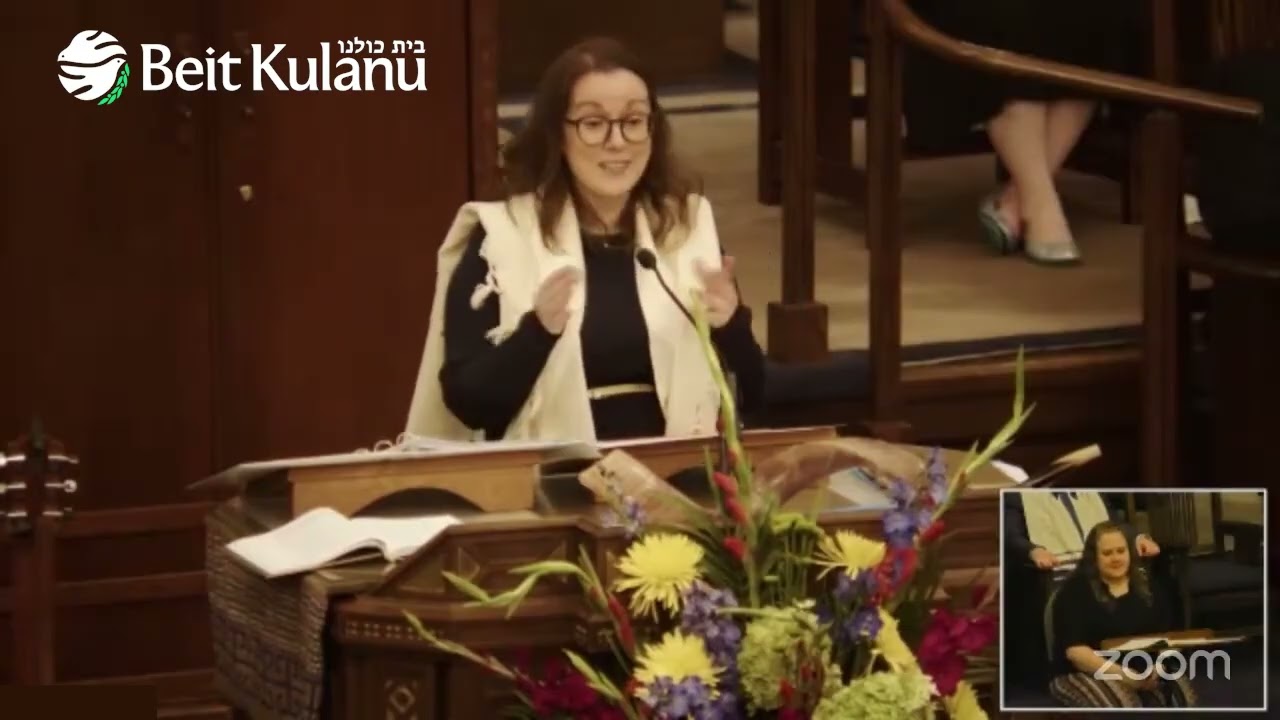
Transcript of Rabbi Erika Purdy-Patrick’s Erev Rosh HaShanah sermon
Remembering Forward
Shanah tovah! I am deeply honored to be joining Beit Kulanu as one of your rabbis. If you had asked me one year ago where I thought I would go after rabbinical school, I don’t think I would’ve mentioned Pittsburgh as an option.
And what a mistake that would’ve been. It’s not that I wrote Pittsburgh off…I just had no idea what a wonderful city it was. While there were many moments where I realized that I liked the spirit of Pittsburgh and of Beit Kulanu, one moment always sticks out. I knew that Beit Kulanu would be home for me because of one deeply thoughtful encounter with Barbara Shuman.
I arrived in an extremely snowy Pittsburgh in February, and was promised that “it’s never like this, this is a once-in-a-decade snow” (we’ll see if that’s true this winter…)
I lived in Los Angeles. The winter gear I owned was a light jacket and some dress pants. I certainly didn’t own any winter appropriate footwear, so I wore some heels, and then I ran into Barbara, who complimented my shoes, but asked “…don’t you have any boots?”
I said “No…I don’t…” and she looked back and forth at our feet, asked my shoe size, and then took HER boots off in the commons so that I could see if they fit my feet. For the record, they fit, so she said she would run home to change into other boots so that I would have snow-proof, warm footwear while I was in Pittsburgh.
She quite literally gave me the shoes off of her feet, an act for which I will forever be grateful. Don’t worry, Barbara, I won’t need to borrow your boots again.
This is what has stood out to me about Pittsburgh and about Beit Kulanu since my interviews in February, and it’s what still stands out to me today – this community is filled with people who are kind, warm, and willing to bend over backwards to help people feel welcome, and to make sure that people have everything they need. These are the values that draw me in and excite me about what we’re doing here at Beit Kulanu.
It’s the value we place on making sure that people feel seen and supported. It’s the value we place on making sure that everyone has a seat at the table, and that they have the proverbial snow boots on their feet that they need. I am truly looking forward to getting to know each and every one of you, to helping all of us all cultivate meaningful and vibrant Jewish lives, and to being in community with you.
Each generation has core communal memories of a historic world event that shifted their understanding of the world and what matters most in life. For many baby boomers, the moment may have been the assassination of John F. Kennedy, or the unfolding of desegregation in American schools. For gen X, maybe it was the end of the Vietnam war, the fall of the Berlin Wall, or the Challenger Disaster. For millennials, I can say with the utmost certainty that September 11th was the core event that impacted and influenced how we understand the world. For gen Z, I believe that the COVID pandemic was the generationally defining moment.
These are the foundational moments that built us, shaped us, and continue to influence how we see the world today. Our memories of these historical events influence/shade our understanding of what’s to come in the future.
And this is an important distinction – memory is not history. My memories of September 11th are not the events themselves, but they are a tapestry, woven from the ways the moment made me feel, the ways I interpreted and understood the events after.
The High Holy Day season asks us to remember, over and over, in different ways and on different topics. We are encouraged to remember our loved ones who have passed away at the Yizkor service, to remember our mortality and our fallibility in Unetaneh Tokef and in the Vidui.
Memory is crucial enough to Judaism that it is woven into every holiday. And, on Rosh Hashanah we see memory in every corner of our liturgy – more so than on other holidays. Rosh Hashanah has a more formal name within our liturgy that highlights the importance of memory, of remembering – this name is Yom HaZikaron, the day of Remembrance.
In the k’dushat hayom, the part of our amidah where we lift up the holiness of the day, we say “Va-titen-lanu, Adonai Eloheinu, b’ahavah et Yom HaZikaron hazeh” – “In Your love, Eternal our God, You have given us this Day of Remembrance.” We are tasked with remembering our journey out of Mitzrayim, acknowledging how far we’ve come, and where we hope to go, all with the help of the Divine.
Memory is also a key part of the shofar service, which is subdivided into three smaller services – Shofarot (shofars), Zichronot (memories or rememberence), and Malkhuyot (acknowledging, in reverence, God’s sovereignty over the universe), each of which has a slightly different focus. Remembering and memory are important enough that the sounding of the shofar is tasked with reminding us, with nudging our souls to remember what matters most.
And this year, even the Gregorian calendar calls on us to remember, but in a very different manner. On the 25th anniversary of the 9/11 attacks, on this Erev Rosh Hashanah, the phrase “never forget” equates to “always remember”. Recall the ways that the day shaped how you move through the world, how you talk to your loved ones about that day, and what shifted in the world at large.
For many millennials, the world shifted that day and in the days that followed, making September 11th a formative moment for our generation that continues to influence how we remember and how we move forward. In hindsight, on an individual level, everything changed for me because of the events on September 11th, 2001.
I was in seventh grade and had a very narrow understanding of what was out in the world beyond my neighborhood. Then, that day and in the days that followed, I came to understand that there is a bigger world out there, one that reaches far beyond what I could see from my window, that there are values humming in the background of our society that I took for granted.
All of these realizations informed the choices I made moving forward: I ended up studying Political Science and International Relations in undergrad, I became deeply passionate about studying human rights, and I ultimately decided to work in refugee resettlement before moving into the Jewish world. Without reflecting on the essence of my memories from September 11th, I don’t think I would have pursued the path I have in life. These gleanings are an example of what it means to remember, to honor our memories, and to continue to move forward with the essence of these memories guiding our actions.
Memory is a cornerstone of our communal Jewish identity – but it is not the only cornerstone. Judaism asks us to honor our memories as we move forward together as a community, over and over again.
For everyone who was part of Rodef Shalom or Temple Sinai, there are core memories that transcend a singular, fixed moment in history. The memories are not rooted in a recitation of dates or names or places, but of the intangible elements that make the dates, names, and places matter.
There are countless examples of this that come up in every conversation I have here at Beit Kulanu – for some Rodef Shalom members, they remember the community building and conversations that occurred when the sisterhood lovingly crafted the many needlecraft pieces, including the red chairs here on the bimah. Is it the building they remember? Is it the chair itself? Not necessarily – they remember how it felt to build community in conversation over needlecraft. They remember the warmth, the generosity of heart, the way that it felt to gather together and bring something beautiful and sacred into the world.
For people who were Temple Sinai members, the kitchen and making meals together often comes up as a cherished memory that goes back decades. Whether people gathered to cook for the Jewish Food Festival or for people in need of a warm meal, the lasting, core essence of the memories shared was rooted in doing this act together, infusing kindness and generosity into their actions. People might remember the menu items, or might remember a few cooking blunders too…but what outlasts these details are the conversations, the connections they made with others while cooking.
Again – the building, the physical details are not at the core of the memory – the way that people felt after the experience is at the core of what is most important.
These memories and the countless others left unmentioned all inform how we approach building Beit Kulanu. The essence of these memories – the warmth, the kindness, the generosity that people remember – these are the intangible, yet essential things we must hold onto as we move forward. All of these intangible, almost indescribable pieces of our memories will clarify what we as a community want Beit Kulanu to become for ourselves, for the broader Jewish community, and for future generations.
So, as we reflect back on these memories, we do so in the spirit of looking forward. We do so with an important question at the center of it all:
What are the foundational values, memories, and experiences that we want to build Beit Kulanu upon?
By asking this, I want to reinforce that I am not asking anyone to forget or disregard their memories of Rodef Shalom or Temple Sinai – in fact, these memories are important and can help influence what we’re building here.
What I am asking us to do is take the time to reflect on our fond memories in our beloved communities and ask yourself a few questions: What did I appreciate about this moment, and why? Who was a part of the moment? What did this moment make me feel? How did this moment inform the rest of my experience moving forward?
When we ask ourselves these questions, we can get closer to the core essence of what we cherished about the memory, about what mattered most in the moment, about what the takeaways were that still resonate with us today.
This reflective process can help us discern what memories and values we hope to build Beit Kulanu upon. It can help us channel our energy into a productive and powerful outlet, into shaping our community as Beit Kulanu.
This lesson is not necessarily novel or unique to our present moment, but is one we can learn from our ancestors in the Torah.
When the Israelites are commanded to remember their plight in Mitzrayim, especially in Deuteronomy, it is essential that we remember that the Israelites of Deuteronomy are likely the descendants of the Israelites who initially fled from Egypt. They are not asked to do exactly as their ancestors always did – they’re commanded to remember. They are commanded to never forget while also being commanded to move forward toward the promised land.
Yosef Hayim Yerushalmi reflects on the commandment for the collective Israelite people to remember, understanding the commandment as rooted in “mythic time” rather than a fixed sense of history. He writes that “Only in Israel and nowhere else is the injunction to remember felt as a religious imperative to an entire people. Its reverberations are everywhere, but they reach a crescendo in the Deuteronomic history and in the prophets.”
To remember is an act that God commands of us, and of the Israelites. To remember is essential for the continuation of the Jewish people. It is an act that requires us to look simultaneously in two directions: back at the past, sometimes a historic moment we did not experience ourselves, and forward to our future, to the moments we might encounter.
Yerushalmi also writes that “If the command to remember is absolute, there is, nonetheless, an almost desperate pathos about the biblical concern with memory, and a shrewd wisdom that knows how short and fickle human memory can be. Not history, as is commonly supposed, but only mythic time repeats itself. If history is real, then the Red Sea can be crossed only once, and Israel cannot stand twice at Sinai.” Only mythic time repeats itself, and both our liturgy and our foundational story within the Torah are urgently, frequently putting this idea front and center for us.
Of course, I am not telling you that history is not real. History IS real – but it is not all-encompassing. It requires context from people with firsthand experience, it requires us to reflect. It requires us to remember, to look back on our emotions and feelings about what we experienced. Memory is the human way of processing history, of reviewing fixed moments in time, in hopes that the essence of what mattered most in the past will make its way into shaping the foundations for what comes next.
I am asking all of us to never forget, and, I am also asking us to reflect on our memories in a productive manner. Just because something was always done in a particular manner in one place or another does not mean that it will be directly copied from one place to Beit Kulanu – instead, we (and I mean WE, all of us) will need to thoughtfully and creatively find ways to infuse the core essence of our memories from previous communities into Beit Kulanu. We will need to find ways to make this space one where future generations have their own, new, core foundational memories to cherish.
The metaphor I like to use for this process is about perfume-making: when we smell a rose-scented perfume, we are not smelling an actual rose freshly clipped from a rose bush. We’re smelling the essence of crushed rose petals, distilled down into an oil.
What we do together at Beit Kulanu will be infused with the essence of what we love about our communities without being a carbon copy of either place. We will honor the essence of our memories, what we loved about our communities, and the intangible components of our memories – all by bringing this energy into what we are building together here at Beit Kulanu.
We must channel the spirit of our Israelite ancestors as we build Beit Kulanu together. By being commanded to both remember the Exodus and march forward toward the promised land, the Israelites were tasked with reflecting on their experiences in order to move forward. They were commanded to reflect on the past, to honor their memories so that they could build something new. So that they could build something that would look and feel different from the past while keeping the essence of their memories at the core.
The same is true for us today – each of us needs to figure out what is at the core of our formative past experiences, to figure out what mattered most in our memories so that we can make it to our land of milk and honey, to build a Beit Kulanu that we love, that we cherish, that we will be proud of as a collective for years to come.